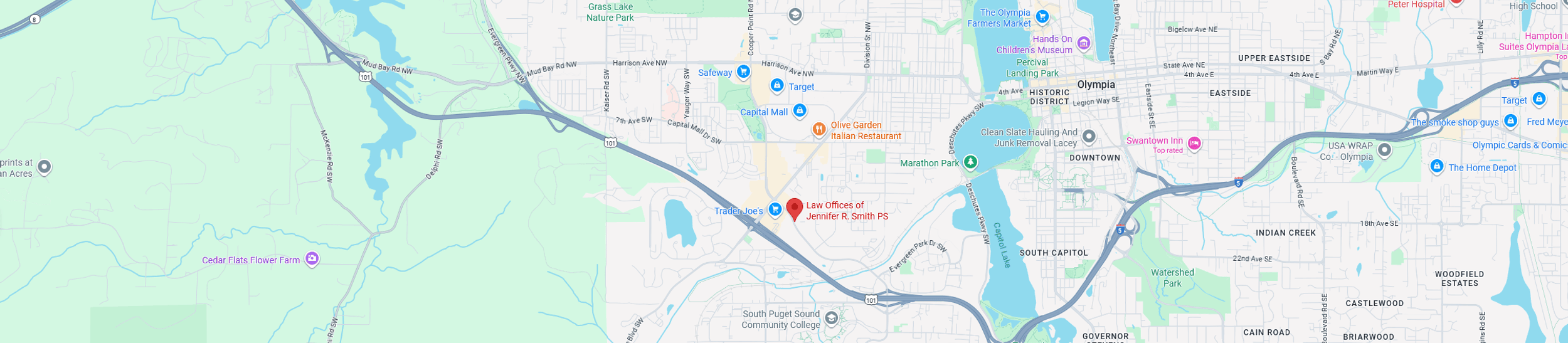
1800 Cooper Point Road STE 12
 M-F: 9:00am - 5:00pm



Family Law Firm in Tumwater, WA
Smith Law Group represents individuals and families in Tumwater and throughout Thurston County in divorce, parenting plans, child support, and related family law matters. We understand that these cases often involve decisions that affect your finances, your home, and your relationship with your children, and we treat each client with the utmost respect and attention. Managing Attorney Jennifer Smith has practiced family law since 2010, and she has handled a wide range of cases, from straightforward filings to deeply involved legal disputes. If you need assistance with a family law matter in Tumwater, call (360) 339-7488 to schedule a consultation.
Legal Issues Within a Family Often Overlap
Divorces include property division, parenting arrangements, and support. Disputes over a parenting plan can affect work schedules, finances, and daily routines. Each decision connects to the next. That's why skilled legal representation is critical not only for your personal situation, but the future you will share with your children.
The court does not evaluate these issues in isolation. Financial disclosures influence support, parenting schedules affect time and expense, and early positions can shape how the case develops over time. You may find that a decision made at the beginning carries through to the final outcome. For example, if a temporary parenting schedule is put in place early and the child remains on that schedule for several months, the court may later view that arrangement as the status quo. The same can happen with temporary support or use of the family home, especially if one side does not raise the issue promptly.
Taking a deliberate approach from the outset can help reduce unnecessary conflict and avoid problems later in the process.
Family Law Services for Cases in Tumwater
Smith Law Group handles cases in Tumwater, Olympia, Lacey, and surrounding areas throughout Thurston County. Family law matters are typically filed in Thurston County Superior Court, and each case proceeds based on its specific facts and circumstances.
Parenting Plans
When parents separate, one of the first questions is how day-to-day life will work for the children. In Washington, that issue is addressed through a parenting plan. The plan covers the residential schedule, decision-making authority, and the process for resolving future disagreements. The court will look closely at the child's needs, each parent's history of involvement, and whether the proposed schedule is realistic.
You will need more than a rough idea of when the child will be with each parent. A workable parenting plan should account for school, transportation, holidays, breaks, and the practical demands of everyday life. If those details are left vague, conflict usually follows.
Child Support
Support often becomes a point of tension very quickly, especially when one or both parents have variable income. The court uses the Washington Child Support Schedule under RCW 26.19, but the math is only as reliable as the information provided. If one parent works overtime, earns commissions, or is self-employed, the numbers may require a closer look.
You should expect to provide financial records and explain your income clearly. The court may also consider healthcare costs, childcare expenses, and other child-related obligations. A support order can stay in place for a long time, so it is worth taking the time to get it right.
Divorce and Separation
A divorce case can pick up speed faster than people expect. Once it begins, you may be dealing with property issues, parenting questions, support, and temporary arrangements all at the same time. Washington law allows a marriage to be dissolved when it is irretrievably broken, and under RCW 26.09.030, at least ninety days must pass after filing and service before the court can enter a final decree.
That waiting period does not mean the case sits still. You may need to address who stays in the home, who pays certain bills, or what the parenting schedule will be while the case is pending. The choices made during that stretch can matter more than people realize.
Civil Protection Orders
Some family law matters involve urgent concerns about safety, contact, or harassment. In those situations, a Civil Protection Order may become part of the case. These orders can affect communication, restrict contact, and in some situations alter how parenting time is handled until the court has more information.
The court may enter a temporary order first and then schedule a hearing. If you are requesting protection, or responding to a request, you will need to present facts that the judge can rely on. These hearings move quickly, and the outcome can carry over into other parts of the case.
Changing Existing Orders
Over time, a support obligation may no longer fit the financial reality, or a parenting schedule may stop working because of a job change, relocation issue, or a child's changing needs. Washington law permits modification in some situations, but not simply because one side wants a different arrangement.
You must show the court that the legal standard has been met. In some cases that means proving a substantial change in circumstances. In others, the issue may involve a more limited adjustment. Either way, the court will want specific facts, not general frustration.
Spousal Maintenance
Spousal maintenance is one of the more case-specific areas of family law. There is no chart that tells the court exactly what to do. Instead, RCW 26.09.090 directs the judge to consider a range of factors, including the length of the marriage, the financial position of each spouse, and the time one spouse may need to become self-supporting.
That means maintenance can look very different from one case to the next. In one divorce, it may involve short-term support while someone gets back on their feet. In another, it may require a broader look at earning capacity, work history, and the standard of living during the marriage. You will need a clear picture of the finances before the issue can be addressed well.
Adoption Matters
Whether the case involves a step-parent adoption or another form of adoption recognized under Washington law, the court expects the paperwork, notice, and consent requirements to be satisfied before anything is finalized.
If parental rights must be terminated first, that adds another layer of legal work. Because adoption creates a permanent legal relationship, the court does not rush through it. You should expect the process to require careful filing, proper notice, and a final hearing before a decree is entered.
How a Family Law Case Typically Proceeds in Tumwater
A family law case usually begins with the filing of a petition in Thurston County Superior Court. After filing, the other party must be formally served. Once service is complete, the case may move toward temporary orders, which address immediate concerns such as parenting schedules or financial support.
You may be required to submit financial disclosures and other documentation early in the process. These materials often form the basis for temporary decisions. In some cases, the parties are able to reach agreements through negotiation or mediation. In others, the court must resolve disputes through hearings.
You will need to respond to deadlines, provide accurate information, and participate in the process as it develops. The timeline varies depending on the level of disagreement and the complexity of the issues involved. Some cases resolve relatively quickly, while others require additional time for the court to reach a final decision.
Frequently Asked Questions About Family Law in Tumwater, WA
Where Are Family Law Cases Filed for Tumwater Residents?
Most family law cases involving individuals in Tumwater are filed in Thurston County Superior Court. The appropriate venue depends on where the parties reside and the nature of the case. If there is uncertainty about where to file, it is important to review the specific circumstances before proceeding.
What Happens After I File for Divorce?
After filing, the other party must be served with the petition. Once service is completed, the case may move toward temporary orders and the exchange of financial information. The process continues through negotiation or court hearings until a final order is entered.
Can Temporary Orders Be Changed Later?
Temporary orders are intended to address immediate issues during the case, but they are not necessarily permanent. In some situations, they may be modified as the case develops. The court will consider updated information before making changes.
What If My Income Changes During the Case?
If your financial situation changes, the court may need updated information. You should be prepared to provide documentation reflecting any changes in income. The court relies on current financial data when making decisions about support.
Do Both Parents Have Equal Rights at the Start?
At the beginning of a case, both parents generally have equal legal standing. The court will evaluate the facts and enter a parenting plan based on the child's best interests. The final outcome depends on the evidence presented.
How Are Disagreements Resolved Without Trial?
Many cases are resolved through negotiation or mediation rather than trial. These processes allow the parties to reach agreements outside of court. Any agreement must still be approved by a judge before it becomes final.
What If the Other Party Ignores Court Deadlines?
Failure to respond to court deadlines can lead to serious consequences, including orders being entered without that party's input. You should follow all deadlines carefully and respond as required to protect your position.
Can We Share Parenting Time Equally?
Equal parenting time is possible in some cases, but it depends on the specific circumstances. The court will evaluate the child's needs, each parent's availability, and how the proposed schedule would function in practice.
What Role Does Mediation Play in Thurston County?
Mediation is often used to help resolve disputes without trial. It provides an opportunity for both parties to discuss issues and attempt to reach an agreement with the assistance of a neutral third party.
How Should I Prepare Before Filing a Case?
Before filing, you should gather relevant documents, including financial records and any existing court orders. Having a clear understanding of your goals and concerns can help you approach the case more effectively.
Speak With a Family Law Firm Serving Tumwater Today
Family law matters often involve decisions that carry long-term consequences. Whether you are addressing divorce, parenting, or financial issues, it is important to approach the process carefully. Smith Law Group handles cases in Tumwater and throughout Thurston County. To discuss your situation, call (360) 339-7488 to schedule a consultation.
Schedule Your Consultation