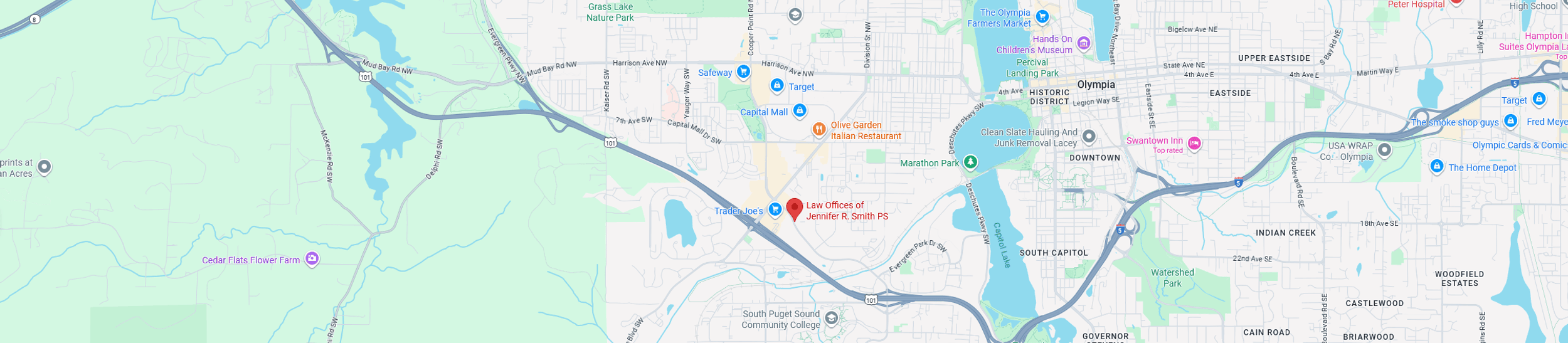
1800 Cooper Point Road STE 12
 M-F: 9:00am - 5:00pm



Divorce Lawyer in Olympia, WA
And Throughout Thurston County and Mason County
Divorce changes nearly every part of your life all at once. It affects your home, your finances, your parenting schedule, and your long-term plans. Even when both parties agree that the marriage is over, the legal process can drag on. Washington law provides a structured framework, but how that framework applies to your situation depends on the facts. Smith Law Group represents clients throughout Olympia, Mason County, Thurston County, Lewis County, and Grays Harbor County in divorce matters, and managing Attorney Jennifer R. Smith has practiced exclusively in family law since 2010. If you are considering divorce, call (360) 339-7488 to schedule a consultation.
Divorce in Washington Is Governed by Statute
Washington is a no-fault divorce state. A marriage may be dissolved if it is "irretrievably broken," and the court does not require proof of misconduct. Note that under RCW 26.09, a divorce cannot be finalized until at least ninety days have passed from the date the petition is filed and served.
During the dissolution process, the court has authority to divide property and debt, enter a parenting plan when children are involved, establish child support, and determine whether spousal maintenance is appropriate. Judges are required to reach a just and equitable result, but that does not always mean a simple fifty-fifty division. Because the court has broad discretion, you need a lawyer who is prepared, experienced, and ready to fight for your best interests in court.
Divorce Representation in the Olympia, WA Area
Smith Law Group represents clients in Olympia, Belfair, Centralia, Chehalis, Lacey, Montesano, Rainier, Shelton, Tenino, Tumwater, Yelm, and surrounding areas in both contested and uncontested divorce proceedings.
Division of Property and Debt
Washington is a community property state. In general, property and income acquired during the marriage are presumed to be community property, while assets owned before marriage or received by gift or inheritance may be considered separate property. That distinction, however, is not always simple in practice. Accounts may be commingled. Real estate may increase in value. Retirement accounts often require tracing and proper allocation.
The court must divide property and liabilities in a manner that is just and equitable after considering the nature of the assets, the duration of the marriage, and the economic circumstances of each spouse. In longer marriages, courts may seek to place the parties in relatively equal financial positions. In shorter marriages, the analysis can differ. Smith Law Group reviews financial records carefully and presents a clear picture of both assets and obligations.
Parenting Plans in Divorce
When children are involved, the court must enter a parenting plan. Washington law focuses on the best interests of the child, with particular emphasis on stability and the child's existing relationships. The court evaluates statutory factors under RCW 26.09.187 when determining residential schedules and decision-making authority.
A parenting plan includes a weekly schedule, but it also addresses holidays, school breaks, transportation, and how future disputes will be resolved. Because these provisions often remain in place for years, one cannot afford to dismissively sign off on the papers. Smith Law Group works with clients to develop parenting plans that reflect both the child's needs and practical realities.
Spousal Maintenance (Alimony)
Spousal maintenance, commonly referred to as alimony, is governed by RCW 26.09.090. The court considers several factors, including the length of the marriage, the financial resources of each spouse, the standard of living during the marriage, and the time necessary for a spouse to gain employment or additional education.
Maintenance is not automatic. In shorter marriages, awards are often limited in duration. In longer marriages, courts may attempt to reduce economic disparity between the parties. Marital misconduct does not determine whether maintenance is awarded. Each case depends on its financial facts. Smith Law Group evaluates income, expenses, and earning capacity to present a realistic and legally grounded position.
Temporary Orders During Divorce
Divorce proceedings can take time. During that period, temporary orders may address residential schedules, child support, spousal maintenance, and use of the family home. These early orders often influence how the case unfolds.
Temporary hearings require preparation. Financial declarations must be completed accurately, and proposed parenting arrangements should be practical and reasonable. While temporary orders are not necessarily permanent, they can shape expectations and financial realities during the case. Careful planning at this stage can prevent unnecessary conflict later.
High-Conflict and Contested Divorce
Not every divorce resolves through agreement. When disputes arise over property division, parenting arrangements, or support, the case may require formal discovery, motion practice, and trial preparation. Financial documents may need to be subpoenaed. Testimony may be required.
When a divorce is contested, financial records may need to be produced, depositions may be scheduled, and motions may be argued before a judge. The court will make decisions based on sworn testimony and documented evidence. In those situations, preparation by an experienced attorney can save you a tremendous amount of heartache. Smith Law Group builds a case on your behalf and presents the facts in a way that allows the court to reach a fair and informed result.
Frequently Asked Questions About Divorce in Washington
How Long Does a Divorce Take in Washington?
Washington law requires a minimum ninety-day waiting period after the petition is filed and served. That is the earliest a divorce may be finalized. In uncontested cases, the process may conclude soon after that period expires. In contested matters involving parenting or complex financial issues, the timeline can extend significantly depending on court schedules and the level of dispute.
What Does "No-Fault" Divorce Mean?
"No-fault" means that neither spouse must prove wrongdoing to obtain a divorce. The court only needs to find that the marriage is irretrievably broken. Allegations of misconduct do not determine whether a divorce will be granted, although financial behavior may be relevant when dividing property.
Do I Have to Go to Court?
Some uncontested divorces can be finalized with minimal court appearances. However, if disputes arise over property, parenting, or support, hearings may be necessary. The level of court involvement depends on whether agreements can be reached and whether contested issues require judicial resolution.
How Is Property Divided in Washington?
Property is divided in a manner that the court finds just and equitable. While Washington is a community property state, equal division is not guaranteed. The court considers the nature of the assets, the duration of the marriage, and the economic circumstances of each spouse before entering an order.
Can My Spouse Stop the Divorce?
A spouse cannot prevent the court from granting a divorce if one party asserts that the marriage is irretrievably broken. However, a spouse may contest issues such as property division, parenting plans, or maintenance. Those disputes must be resolved before the final decree is entered.
How Is Spousal Maintenance Determined?
The court evaluates statutory factors under RCW 26.09.090, including need, ability to pay, length of the marriage, and earning capacity. Maintenance awards vary widely depending on the financial facts of the case. There is no fixed formula.
What Happens to Retirement Accounts?
Retirement accounts accumulated during the marriage are often considered community property. Division may require a Qualified Domestic Relations Order, depending on the type of account. Accurate valuation and proper drafting are important to avoid unintended tax consequences.
Who Pays Attorney's Fees?
The court has authority to award attorney's fees based on one party's financial need and the other party's ability to pay. In some cases, fees may also be awarded if one party's conduct increases litigation unnecessarily. The decision is discretionary.
Can We Agree on Everything?
Yes. If both parties reach agreement on property division, parenting arrangements, and support, the court may approve a settlement so long as it complies with Washington law. Even in agreed cases, proper drafting and statutory compliance remain important.
When Is a Divorce Final?
A divorce becomes final when the court signs the Decree of Dissolution. Once entered, the marriage is legally terminated, and the terms of the decree become enforceable court orders.
Speak With a Divorce Lawyer in Olympia Today
Divorce affects your financial stability, your parenting arrangements, and your future planning. Having experienced legal guidance from the beginning can make a significant difference. Smith Law Group represents clients throughout Olympia, Thurston County, Mason County, Lewis County, and Grays Harbor Counties in divorce matters, and if you would like to discuss your situation, call (360) 339-7488 to schedule a consultation.
Schedule Your Consultation