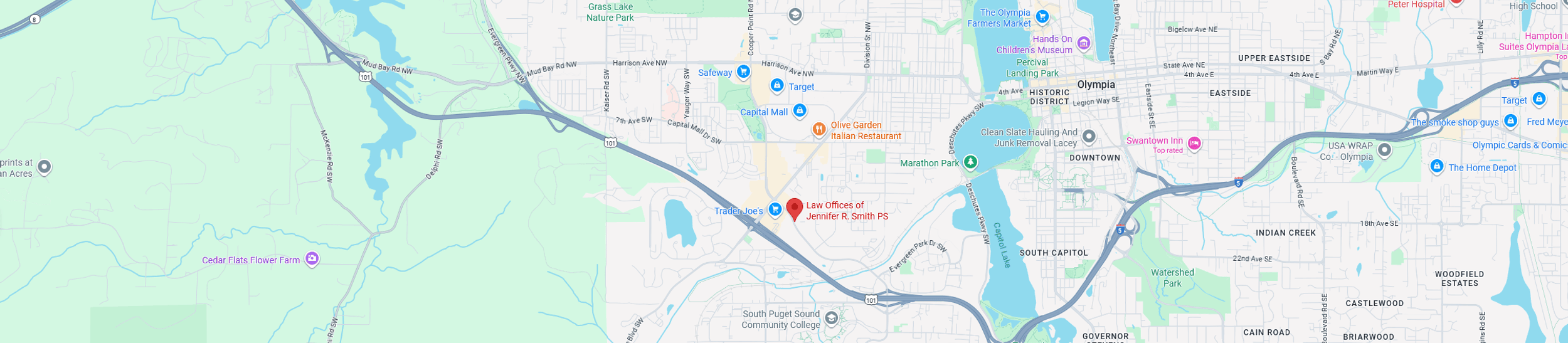
1800 Cooper Point Road STE 12
 M-F: 9:00am - 5:00pm



Child Support Attorney in Olympia, WA
And Throughout Thurston, Mason, Lewis and Grays Harbor Counties
Child support affects your monthly budget, your long-term financial planning, and most importantly, your child's stability. While Washington uses a statutory formula to calculate support, the numbers are not always straightforward. Consider disputed income, overtime, bonuses and other forms of income. Each can complicate the calculation. Parents can even disagree about child care or healthcare costs. An order entered today can remain in place for years, so call Smith Law Group for strategic representation. We represent parents throughout Olympia, Thurston County, Mason County, Lewis County, and Grays Harbor Counties in child support matters, and if you have questions about establishing or modifying support, reach us at (360) 339-7488 to schedule a consultation.
Child Support in Washington Is Governed by Statute
Child support in Washington is governed by the Washington Child Support Schedule, codified in RCW 26.19. The statute establishes a standard calculation based primarily on the income of both parents. Courts begin with gross monthly income, apply statutory deductions, and then determine each parent's proportional share of the total support obligation.
The court may also consider healthcare costs, daycare expenses, extracurricular activities, and other child-related expenses. In certain circumstances, a deviation from the standard calculation may be appropriate, but deviations are not automatic and must be supported by written findings.
Child Support Representation
Smith Law Group represents parents in Olympia, Belfair, Centralia, Chehalis, Lacey, Montesano, Rainier, Shelton, Tenino, Tumwater, Yelm, and surrounding areas in child support proceedings connected to divorce, parentage, and modification cases.
Establishing Child Support
Child support is typically established during a divorce, a parentage action, or a parenting plan proceeding. The process requires full financial disclosure from both parents. Pay stubs, tax returns, and other documentation are reviewed to determine monthly income. When income fluctuates or documentation is incomplete, disputes can arise.
An initial support order sets the framework for years to come. If income is calculated incorrectly or relevant expenses are overlooked, correcting the order later may require formal modification proceedings. Smith Law Group works to confirm that income figures are accurate and that statutory requirements are followed before the court enters an order.
Calculating Income and Disputed Earnings
Income calculation is often the most contested aspect of child support. Overtime, bonuses, commissions, and self-employment income can complicate the analysis. Courts may also address situations where a parent is voluntarily unemployed or underemployed. In those cases, the court has authority to impute income based on earning capacity.
Self-employed parents may need to provide business records in addition to tax returns. Disputes over income frequently require careful review of financial documents and, in some cases, testimony.
Deviations From the Standard Calculation
Although RCW 26.19 provides a standard formula, the court has limited authority to deviate from that calculation in appropriate circumstances. Deviations may be considered when parents share significant residential time, when a child has special medical or educational needs, or when other children are involved.
The court must enter written findings explaining any deviation. Simply agreeing that a different amount "feels fair" is not enough. Smith Law Group evaluates whether a deviation is legally justified and presents the supporting facts to the court when appropriate.
Modification of Child Support
Child support orders are not necessarily permanent. Under Washington law, modification may be available when there has been a substantial change in circumstances or after certain statutory time periods have passed. Job loss, significant income increases, changes in parenting time, or new financial obligations can all trigger review.
However, modification requires a formal court process. Support does not change automatically simply because circumstances shift. In some cases, postsecondary educational support may also be addressed if a child pursues college or vocational training. Smith Law Group reviews the facts carefully before filing for modification and guides clients through the required legal steps.
Postsecondary Educational Support
Washington courts have authority to order postsecondary educational support for a child who attends college or vocational school. This support may extend beyond age eighteen and, in some cases, through age twenty-three. The court considers factors such as the child's academic performance, the financial resources of the parents, and the standard of living the child would have enjoyed had the family remained intact. The court does retain discretion; postsecondary support is not automatic.
Frequently Asked Questions About Child Support in Washington
How Is Child Support Calculated in Washington?
Child support is calculated under the Washington Child Support Schedule, RCW 26.19. The court begins with each parent's gross monthly income, applies statutory deductions, and determines the combined support obligation. Each parent is then responsible for a proportional share. Additional expenses such as healthcare or daycare may be added to the base support amount.
What Income Is Included in Child Support?
Income may include wages, overtime, bonuses, commissions, and certain self-employment earnings. Courts examine tax returns, pay stubs, and other financial records. If income fluctuates or a parent has irregular earnings, the court may average income over time to reach a fair monthly figure.
Can a Parent Hide Income?
If a parent fails to disclose income accurately, the court may require additional documentation or impute income based on available evidence. Business records, bank statements, and prior tax filings may be reviewed. Providing incomplete information can undermine credibility and affect the court's decision.
What Happens If a Parent Refuses to Pay?
Failure to pay child support can result in enforcement actions, including wage garnishment, interception of tax refunds, suspension of licenses, and other remedies. Child support orders are legally enforceable, and unpaid amounts may accrue interest.
Can Child Support Be Reduced?
Child support may be reduced through a formal modification proceeding if statutory criteria are met. A substantial change in circumstances, such as job loss or a significant income reduction, may justify review. The court evaluates updated financial information before entering a new order.
How Often Can Child Support Be Modified?
Modification may be requested after a substantial change in circumstances or after certain statutory review periods, depending on the facts of the case. Not every financial change qualifies. The court examines whether the statutory standard has been satisfied before adjusting the order.
Does Shared Custody Eliminate Child Support?
Shared residential time does not automatically eliminate child support. While parenting time may be a factor in determining whether a deviation is appropriate, the statutory calculation still applies. Courts examine income levels and the overall financial impact before adjusting support.
What Is Postsecondary Educational Support?
Postsecondary educational support refers to financial support for a child attending college or vocational school. Courts may order this support beyond age eighteen based on statutory factors, including financial ability and the child's academic progress.
When Does Child Support End?
Child support typically ends when the child turns eighteen or graduates from high school, whichever occurs later. If postsecondary educational support is ordered, payments may continue beyond that point. The specific termination date is usually stated in the court order.
Can We Agree to a Different Amount?
Parents may reach agreements regarding support, but the court must approve the final amount. Any agreement must comply with statutory guidelines or include proper findings supporting a deviation. The court retains authority to reject agreements that do not meet legal standards.
Speak With a Child Support Lawyer in Olympia Today
A child support order affects your finances for years. Getting it right at the outset matters. Whether you are establishing support, disputing income, or seeking modification, Smith Law Group represents parents throughout Olympia, Thurston County, Mason County, Lewis County, and Grays Harbor County with steady and experienced guidance. If you would like to discuss your situation, call (360) 339-7488 to schedule a consultation.
Schedule Your Consultation