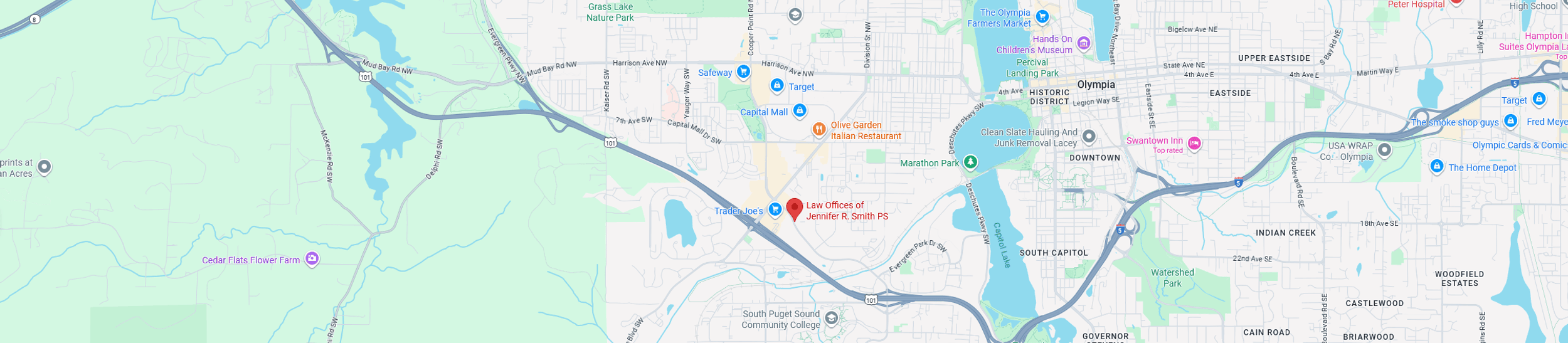
1800 Cooper Point Road STE 12
 M-F: 9:00am - 5:00pm



Child Custody Lawyer in Olympia, WA
Serving Throughout Thurston County and Mason County
Disputes over children are often the most difficult part of any family law case. The court is deciding on where a child will live, how decisions will be made, and how parents will share responsibility going forward. This genuinely shapes the rest of the child's life.
In Washington, the legal term is "parenting plan," not custody, but the stakes are the same. Even the early hearings strongly influence the entire direction of the case, and Smith Law Group represents parents during parenting plan proceedings. Managing attorney Jennifer R. Smith has practiced exclusively in family law since 2010. If you need guidance regarding your child, call (360) 339-7488 to schedule a consultation.
Child Custody in Washington Is Determined Through Parenting Plans
Washington law does not use traditional custody labels such as "sole custody" or "joint custody." Instead, courts enter parenting plans under RCW 26.09. A parenting plan sets out the residential schedule, identifies which parent will make major decisions, and establishes a method for resolving future disputes.
The court's primary consideration is the child's best interests, with particular weight given to the child's relationship with each parent and the history of caregiving. Stability is important. Judges examine how responsibilities have been handled in the past and how a proposed schedule will function in practice. The final plan must be workable for the child, whether it is preferred or not by one parent.
Custody Representation in Olympia, Thurston County, and Mason County
Smith Law Group represents parents in Olympia, Belfair, Centralia, Chehalis, Lacey, Montesano, Rainier, Shelton, Tenino, Tumwater, Yelm and surrounding areas in parenting plan and custody-related proceedings.
Establishing a Parenting Plan
A parenting plan is typically established in a divorce or parentage action. Both parents submit proposed schedules, and the court evaluates statutory factors under RCW 26.09.187. The court looks at the strength and stability of the child's relationship with each parent, each parent's past involvement in daily care, and the child's emotional and developmental needs.
There is no automatic presumption that one parent will be designated primary residential parent. The court focuses on the practical realities of the child's life. School schedules, work commitments, transportation logistics, and the child's established routines all matter. A well-drafted parenting plan addresses not only regular residential time, but also holidays, vacations, and how disagreements will be handled in the future.
Modifying a Parenting Plan
Parenting plans are not easily changed. Washington law requires a threshold showing before a court will consider a major modification. Under RCW 26.09.260, a parent must demonstrate a substantial change in circumstances and that modification is in the child's best interests. The statute reflects the court's preference for stability.
Minor modifications may be available under more limited standards, often involving adjustments to residential time. Even then, the court examines whether the requested change disrupts the child's established environment. A parent's frustration with the existing schedule, standing alone, is not enough.
Relocation of a Child
When a parent with primary residential time seeks to move with a child, Washington's Relocation Act applies. The relocating parent must provide formal written notice. The other parent has the right to object, which may trigger a court hearing.
Relocation cases involve statutory factors and a structured burden-shifting analysis. The court weighs the child's relationship with both parents, the reasons for the move, and the impact on the child's quality of life. These cases are fact-intensive and often time-sensitive. Prompt action is important when relocation is proposed.
Minor Guardianships and Non-Parent Petitions
In limited circumstances, a non-parent may seek court involvement regarding a child. Washington law has evolved in this area. Traditional nonparental custody actions have been replaced by minor guardianship proceedings under RCW 11.130. At the same time, the de facto parent doctrine, recognized in In re Parentage of L.B., may allow an adult (who is not a biological parent) who has functioned as a parent to seek legal recognition.
These cases carry constitutional implications because parents have a fundamental right to raise their children. A court will not interfere lightly. A non-parent must meet a high legal standard, often involving proof that remaining with a legal parent would result in actual detriment to the child. If you have questions about a potential third-party case, give us a call for representation that can move the needle.
Emergency and Temporary Custody Orders
When immediate concerns arise regarding a child's safety or stability, temporary orders may be requested. In some situations, a parent may seek emergency relief or a restraining order. Courts act cautiously in these matters, since allegations absolutely must be supported by specific facts.
Temporary parenting arrangements entered early in a case can influence how the court views the situation moving forward. Financial declarations, proposed schedules, and sworn statements must be prepared carefully.
Frequently Asked Questions About Child Custody in Washington
What Is the Difference Between Custody and a Parenting Plan?
In Washington, the term "custody" is largely replaced by "parenting time." A parenting plan outlines where a child resides, how major decisions are made, and how disputes will be resolved. While people often use "custody" conversationally, the legal document governing parental rights and responsibilities is the parenting plan entered under RCW 26.09.
How Does the Court Decide Where a Child Lives?
The court evaluates statutory factors with emphasis on the child's existing relationships and history of care. Judges consider which parent has provided parenting functions, how transitions will affect the child, and whether the proposed schedule is realistic. The focus remains on the child's stability and long-term well-being.
Can a Parenting Plan Be Changed?
Yes, but modification requires meeting high statutory standards. A parent seeking a major change must demonstrate a substantial change in circumstances under RCW 26.09.260. Courts do not modify parenting plans simply because one parent is dissatisfied.
What Is the Difference Between a Major and Minor Modification?
A major modification alters the child's primary residence. Minor modifications involve limited adjustments to residential time. Courts evaluate how the requested change will affect the child's established environment. Regardless, a change in circumstance is required for both types of modifications.
Can a Parent Move Out of State With a Child?
Relocation is governed by Washington's Relocation Act. The relocating parent must provide formal notice, and the other parent may object. If an objection is filed, the court will hold a hearing and apply statutory factors. Relocation is not automatic, even when one parent has primary residential time.
What Is a Guardian ad Litem?
A guardian ad litem, often referred to as a GAL, may be appointed to investigate and provide recommendations regarding a child's best interests. The GAL interviews the parents, reviews records, and may speak with the child. The GAL's findings are not binding, but courts often consider them carefully.
Can Grandparents Seek Custody?
Grandparents and other non-parents may seek court involvement through minor guardianship proceedings in limited circumstances. Because parents have constitutional rights, non-parent petitions face a high legal threshold. The court requires substantial proof before granting custody or guardianship to a third party.
What Happens If the Other Parent Violates the Parenting Plan?
If a parent fails to comply with a parenting plan, the other parent may file a motion for contempt or enforcement. The court can impose remedies, including makeup residential time or sanctions. Repeated violations may have broader consequences, such as loss of parenting time.
Does the Child Get to Choose Where to Live?
A child's preference may be considered depending on age and maturity, but it is not determinative. The court retains final authority and evaluates all statutory factors before making a decision. The child's best interests remain the controlling standard.
How Long Does a Custody Case Take?
The timeline depends on whether the case is contested and whether evaluations or guardian ad litem investigations are required. Temporary orders may be entered early, but final resolution can take several months or longer in complex matters. Court scheduling and the level of dispute both affect timing.
Speak With a Child Custody Lawyer in Olympia Today
A parenting plan shapes your child's daily life for years. Decisions made during a custody case often carry long-term consequences. Smith Law Group represents parents throughout Olympia, Thurston County, Lewis County, Grays Harbor county, and Mason County with steady and careful legal representation. If you need assistance regarding a parenting plan, call (360) 339-7488 to schedule a consultation.
Schedule Your Consultation